LOADING

Vinny · The book
“One second. Counting the house money.”
“One second. Counting the house money.”
You can have an edge and still go broke. Bankroll management is how you stay alive long enough for the math to work.

Bankroll management is sizing your bets so a normal losing streak can't ruin you. The core rule is to risk only 1–5% of your bankroll per play — most pros bet a flat 1 unit — because even a real edge loses several bets in a row, and survival is what lets the math work.
I don't care if you have a 5% edge on a bet. Bet your entire bankroll on it and lose three times in a row — and you will lose sometimes, even with an edge — and you're done. You can't play anymore.
The math says you'll win in the long run. But the "long run" requires surviving the short run. My job is to make sure the short run kills you first. That's why I love promoting big parlays. People get one hit and scale up. Bet sizing goes haywire. The edge evaporates because the emotional sizing is wrong.
I had a decent run in October 2024. Won 7 out of 10, made about $800. I felt like I had it figured out. I bumped my unit size because obviously I'd been betting too small.
November: went 4-10. Lost over $1,100. Ended the month down after a great October, with less money than I started both months combined. The winning streak taught me bad lessons and the higher stakes punished me for learning them. I've learned more from that two-month lesson than from anything else.
Bankroll management is not optional. It's the discipline that carries you through the losing stretches every edge produces.
The core principle: never bet more than 1–5% of your total bankroll on a single play. Variance is real. Even a 5% edge doesn't mean you win every bet. You will lose stretches — multiple in a row. The question isn't whether downswings happen. It's whether you survive them.
Flat betting: every bet is the same size (1 unit = 1% of bankroll). Clean, simple, emotionless. Most professional bettors use flat or very close to it. What to never do: chase losses with bigger bets, scale up after a hot streak, or place "make it back" bets on games you haven't analyzed. The math only works if you're alive to play it.
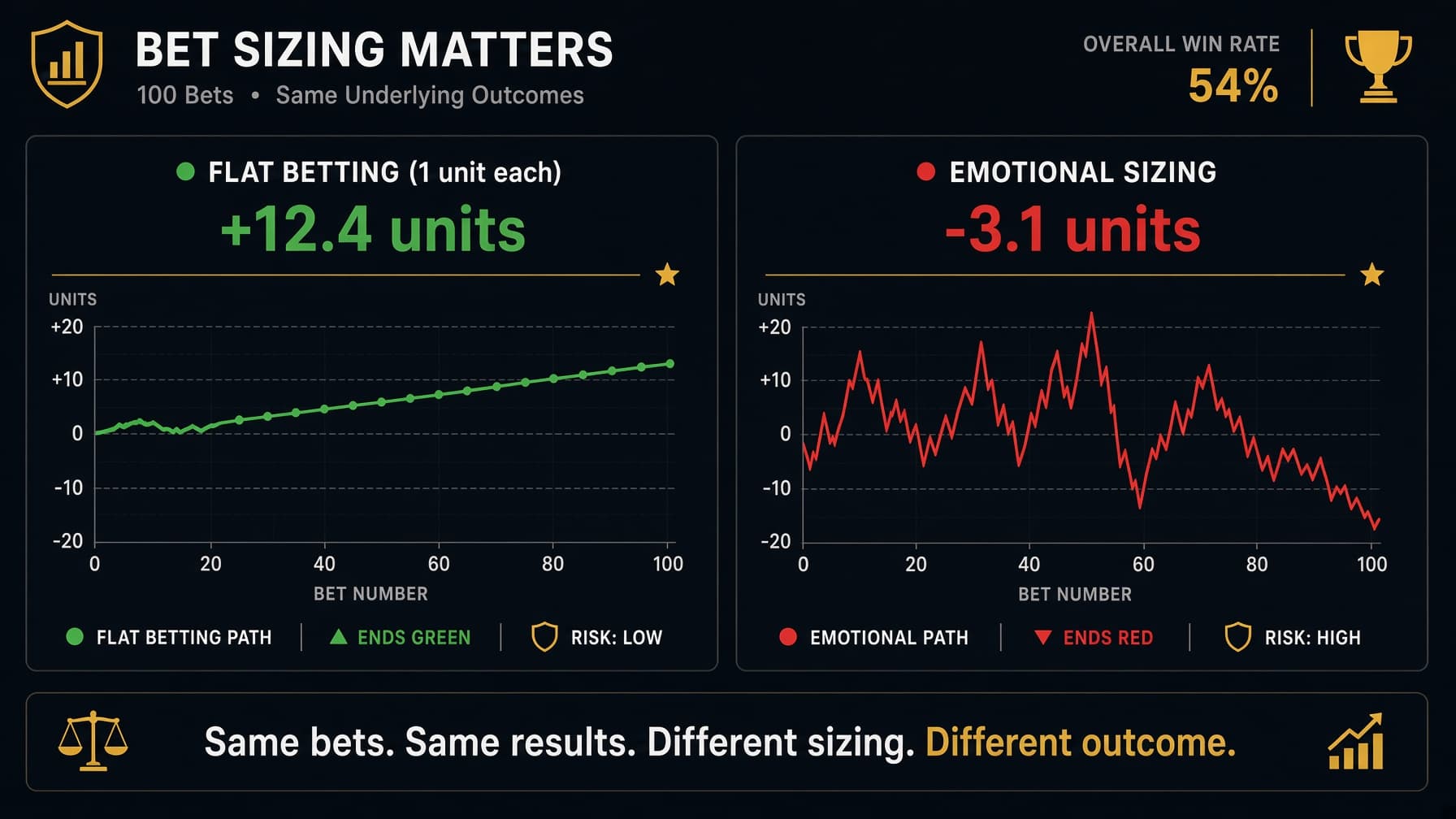
Most disciplined bettors risk 1–5% of their total bankroll on a single play, and many bet a flat 1% (one unit). Smaller sizing survives the inevitable losing streaks.
Flat betting means staking the same amount on every play, regardless of confidence or recent results. It removes emotion from sizing and is the default for most professionals.
Yes. Betting too large means a normal downswing — several losses in a row, even with an edge — can wipe out the bankroll before the edge has time to pay off.