LOADING

Vinny · The book
“One second. Counting the house money.”
“One second. Counting the house money.”
Win rate is the story you tell yourself. ROI is the truth. They are almost never the same number.
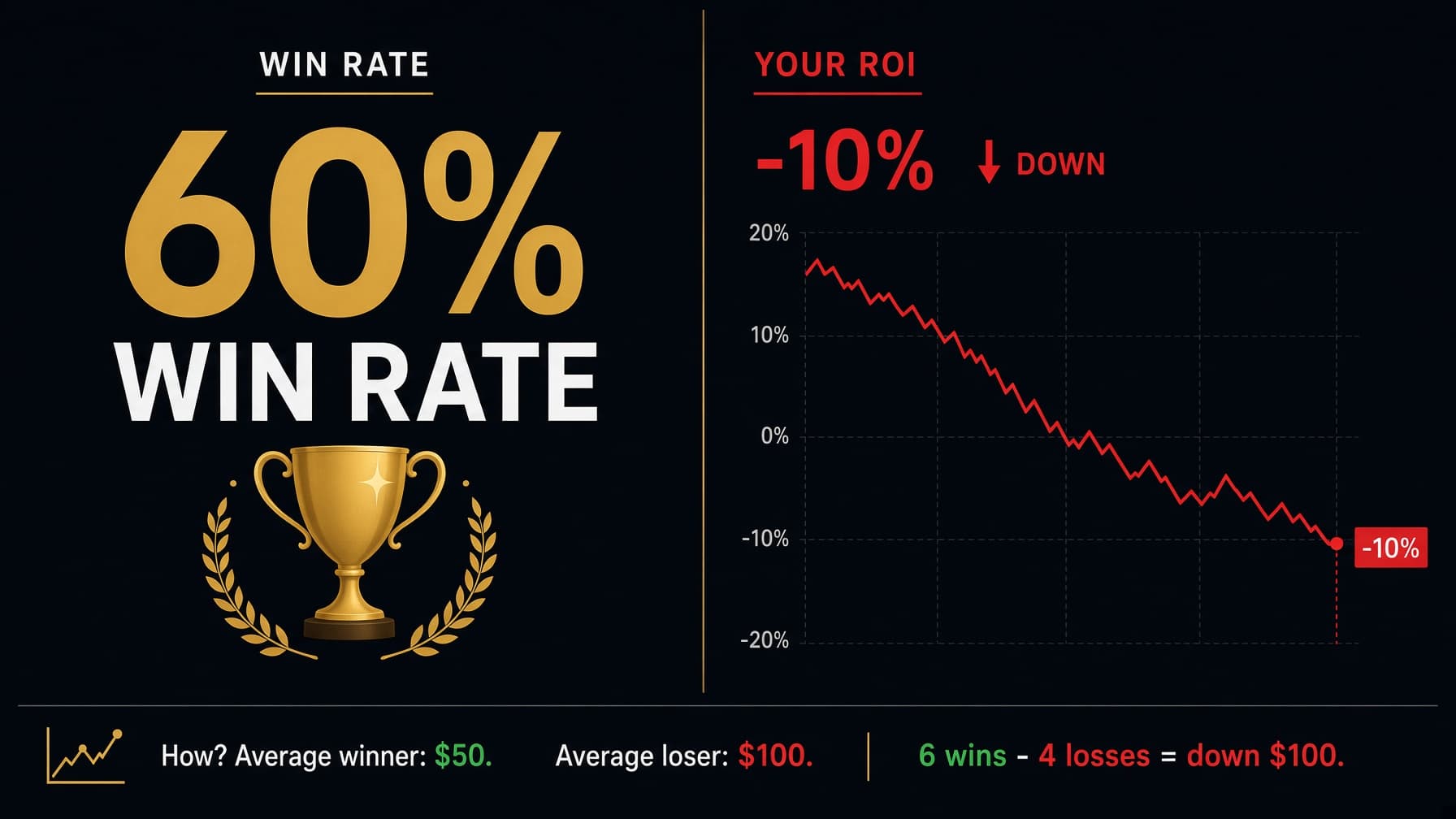
Win rate is how often you win; ROI is whether winning is making you money. They diverge whenever your average winner pays differently than your average loser costs. Ten bets at -200, going 6-4, is a 60% win rate and a -10% ROI — you won more bets and still lost money.
Win rate is my favorite number for people to advertise. "60% winners" sounds incredible. I love when a tout sells that.
Here's what they don't say: if all those picks are -200 favorites, the winners pay $50 and the losers cost $100. Go 6-4 and lose money. Meanwhile I collected vig on all 10 bets. Win rate is a marketing metric. ROI is the truth. I am very happy for you to focus on win rate.
I followed a guy on Twitter for a full season who claimed a 61% win rate on his picks. Impressive. I started tailing him.
Three months later I had made money on fewer than half my bets and had less in my account than when I started. I went back through his picks and realized he was mixing -200 favorites with +100 dogs. His average winner paid way less than his average loser. A 61% win rate on those plays actually loses money. He's still tweeting. 63% this season, he says.
Win rate is how often you're right. ROI is whether being right is making you money. They diverge whenever your average winner pays differently than your average loser costs.
Example: 10 bets, 6 wins, 4 losses. Win rate: 60%. But all bets at -200: wins pay $50 × 6 = $300. Losses cost $100 × 4 = $400. Down $100 on a 60% win rate. ROI = -10%. The inverse works too: 45% win rate on +150 underdogs is profitable. Win pays $150 × 4.5 = $675. Lose costs $100 × 5.5 = $550. Up $125. ROI = +12.5%.
At EE, we track units and ROI — not win rate. A pick isn't good because it wins. It's good because it returns more than it costs, over time, at the prices we got.
Win rate is the share of bets you win. ROI (return on investment) is your profit divided by the total you risked. A high win rate on short-priced favorites can still produce a negative ROI.
If every bet is at -200, each win pays $50 and each loss costs $100. Six wins ($300) minus four losses ($400) leaves you down $100 — a 60% win rate at -10% ROI.
Win rate is a marketing metric that hides the prices you paid. ROI in units measures whether your bets return more than they cost over time — the only number that reflects real profit.