LOADING

Vinny · The book
“One second. Counting the house money.”
“One second. Counting the house money.”
Moneylines sound simple — just pick the winner. But heavy favorites can drain your bankroll even when you're "right."
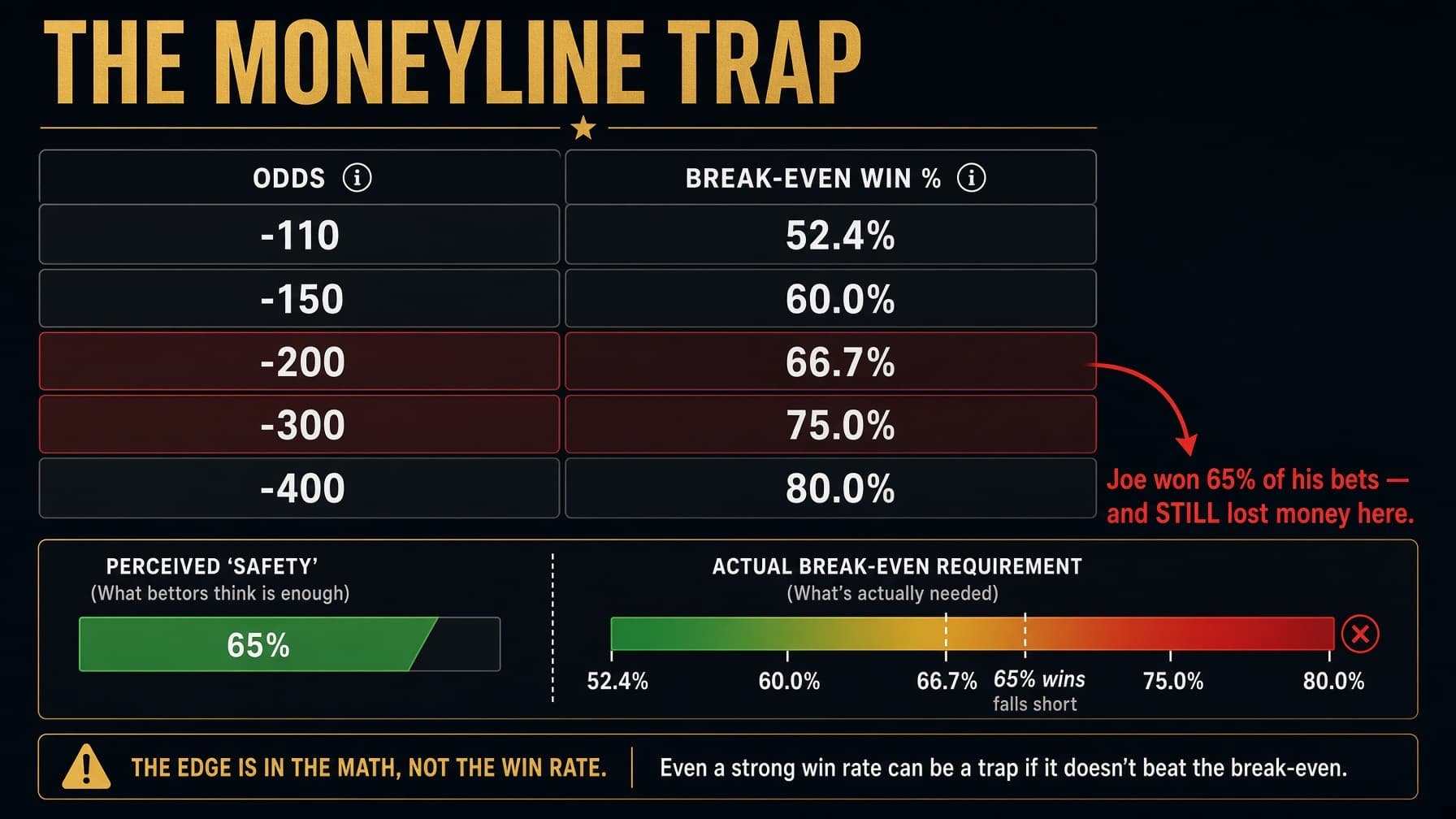
A moneyline bet is a wager on the outright winner, with no spread. The catch is the price: a -200 favorite pays $50 on a $100 stake and needs to win 66.7% of the time to break even, so betting "safe" favorites can lose money even at a 60%+ win rate.
People love the moneyline because it feels honest. Just pick who wins. Simple. Clean.
Here's what they don't see: on big favorites, I crank the juice way up. You want the Dodgers at -250 against a .400 team? Fine. You need them to win 71.4% of the time to break even. If they actually win 68% — which would be outstanding — you lose money betting them every game. Favorites look safe. They lose often enough to drain your bankroll slowly. That's not an accident.
I went through a phase where I just bet heavy favorites on the moneyline every day. I called it "grinding." I thought I was being conservative.
I won like 65% of my bets. I also lost money. For a month I couldn't figure out why my account kept going down if I was winning most of my bets. Then someone walked me through the math on moneyline payouts and I wanted to throw my laptop out the window.
The moneyline is simple: pick the winner, no spread. The problem is the math. Heavy favorites carry heavy juice, and the break-even math is brutal.
The break-even math climbs fast. At -110 you need 52.4%; at -200, 66.7%; at -400, a brutal 80.0%. A team priced at -300 has to win 75% of the time just for you to break even — and most "obvious" favorites win far less than the public assumes.
The moneyline is best for underdogs you genuinely believe are mispriced — you get paid more than their real probability warrants. Worst use: "safe" bets on heavy favorites. The safety is an illusion. The math is working against you.
It is a bet on which team wins the game outright, with no point spread. The odds set the payout: favorites pay less than your stake, underdogs pay more.
Because heavy favorites pay little. At -200 you risk $100 to win $50, so a 66.7% win rate only breaks even — win any less than that and the math turns negative.
Moneylines are strongest on underdogs you believe are mispriced, where the payout is larger than their real chance of winning. They are weakest as "safe" bets on big favorites.