LOADING

Vinny · The book
“One second. Counting the house money.”
“One second. Counting the house money.”
Totals betting removes team allegiance from the equation. That's either freeing or a different kind of trap, depending on how you use it.
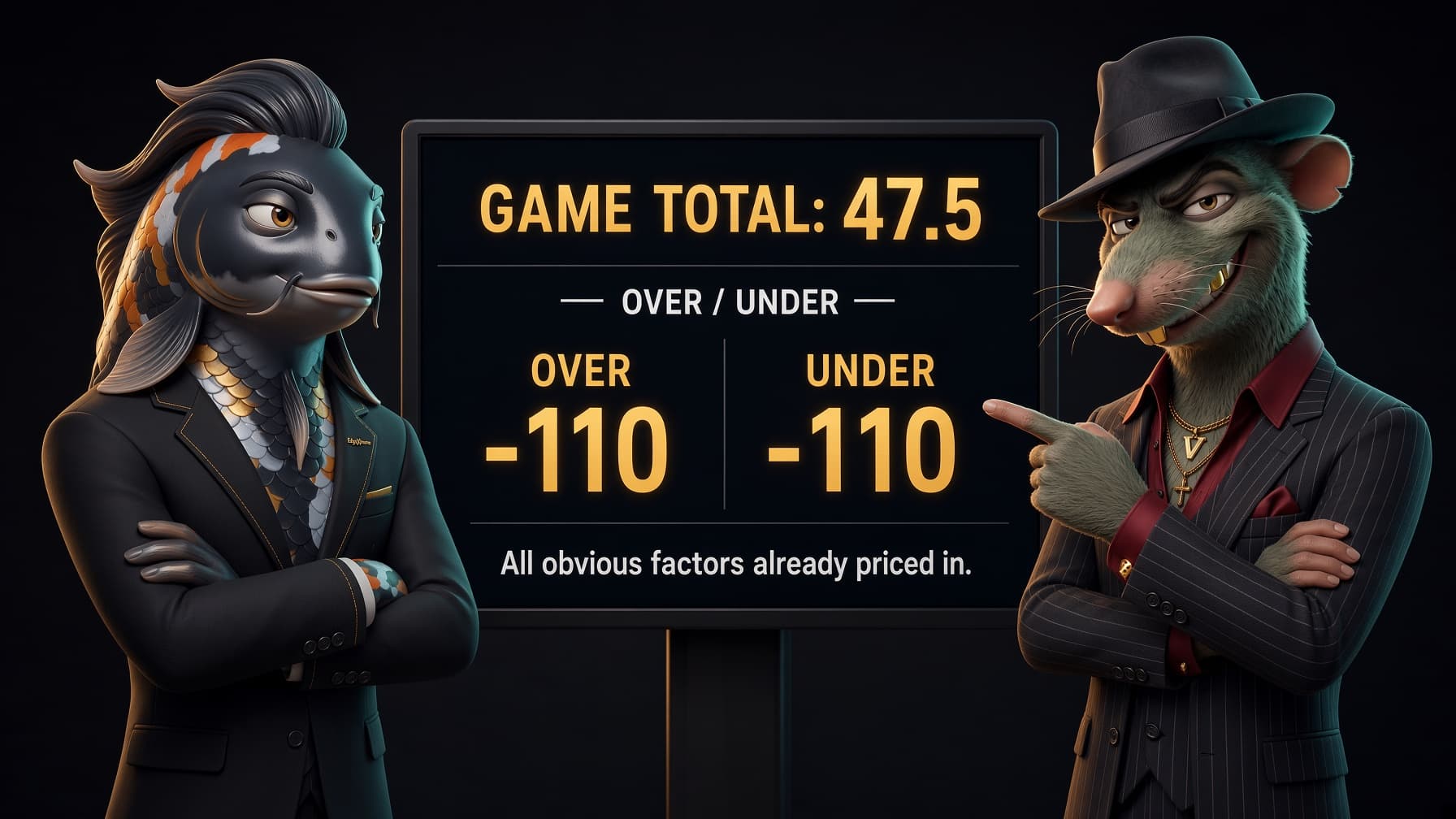
An over/under bet is a wager on whether both teams' combined score finishes above or below a number the book sets. Because the total already prices in obvious factors like strong offenses, real edges come from situational inputs — weather, rest, travel, and pace — that the market is slow to adjust.
Totals are my cleanest market. I set a number, you bet whether the combined score is higher or lower. You don't have to pick a side — you just need to know how many points will be scored. Sounds approachable.
Here's the thing: setting totals is an art. I factor in pace, weather, injuries, referee tendencies, game scripts. I have people whose only job is to price totals. You have intuition and vibes about whether both offenses are "hot" right now. I like my chances.
I used to love totals because I thought I was good at them. No teams to root for, just pick a number. "These defenses are bad, take the over." Clean reasoning.
I never once thought about the line itself. I'd bet overs on high-powered offenses regardless of what the number was. If the total was set at 57.5, I still bet the over because both teams score a lot. The book already knew both teams score a lot. That was already in the number.
Totals betting is conceptually clean: the combined score either clears the number or it doesn't. But the same rules apply — the line is already pricing in everything obvious. Obvious overs on high-powered offenses are usually bad bets because the number already accounts for it.
Where totals create value: situational inefficiencies. Teams playing their second game in two days with long travel. NFL teams coming off a bye with defensive coordinators who had extra prep time. Weather conditions the book may be slow to adjust to. Rain, wind, cold — each affects scoring in documented, measurable ways, and the number is often slow to move with them.
It is a bet on the combined final score of both teams against a line the book sets. "Over" wins if the total is higher; "under" wins if it is lower.
Because the book already knows those teams score a lot and has priced it into the number. You are paying for information the market has already reflected.
Measurable, documented factors: wind and cold suppress scoring, pace and rest push it up or down, and injuries to key scorers shift it. Those situational edges are where totals value lives.